


If your starter isn’t rising, the issue may be related to temperature, feeding, flour, or other details. The good news? Most problems can be fixed easily. Here are the main solutions:
- Adjust the temperature: Sourdough starter ferments best between 21°C and 29°C. If it's too cold, it slows down; if it's too warm, the microorganisms may be affected.
- Feed correctly: Follow a regular schedule (once a day at 21–24°C or twice a day if it’s warmer). Use the 1:1:1 ratio (starter:water:flour).
- Change the flour: Wholegrain flours (rye or whole wheat) are richer in nutrients than refined ones and can revitalize the sourdough starter.
- Regulates hydration: The starter should have the consistency of pancake batter. If it's too thin or too thick, adjust the water-to-flour ratio.
- Fix the issues: Unusual smells or layers of liquid may indicate overfermentation. If there is mold or pink spots, discard the starter.
- Strengthen the sourdough starter: Feed it regularly for 1–2 weeks, until it doubles in volume in 4–8 hours.
With patience and consistency, your sourdough starter can come back to life and become the perfect base for bread.
10. The most common problems encountered in dough and how to fix them
Adjust the Temperature
The temperature plays an essential role in the activity of the sourdough starter. If you notice that your starter is not rising or is developing very slowly, the temperature in your kitchen may not be suitable. Fermentation, a biological process controlled by lactic acid bacteria and wild yeasts, depends on a warm environment to work efficiently.
When the temperature is too low, the microorganisms slow down their activity or even stop altogether, and the starter remains "dormant," with no obvious signs of fermentation. On the other hand, a temperature that is too high can stress or even destroy the beneficial microorganisms, preventing proper fermentation. Let's see what the optimal temperature range is and what solutions are available to fix the problem.
The Correct Temperature Range
Fermentation works best between 21°C and 29°C. Within this range, bacteria and yeast produce carbon dioxide, which helps the sourdough starter rise and form bubbles. Below 21°C, the process becomes very slow, and the starter may need 12–24 hours or more to show signs of activity. During winter, when the ambient temperature drops, the starter may seem “sluggish” because the microbial processes slow down.
After feeding the starter, watch what happens: if, after 6–8 hours, you don’t see bubbles, an increase in volume, or notice the characteristic smell, the temperature is probably too low. Another sign is the appearance of a layer of liquid on the surface, which indicates fermentation that is too slow.
On the other hand, if the starter rises quickly (in just 2–3 hours), but then collapses and develops an overly strong smell, the temperature is too high. Accelerated fermentation quickly uses up the nutrients, which affects the quality of the starter.
If you suspect that the temperature is the cause, here are a few simple ways to warm the sourdough starter.
How to Warm Up the Starter
If the environment in the kitchen is too cold, try these solutions to ensure a more suitable temperature:
- Near a heat source: Place the sourdough starter jar near a radiator, but avoid direct contact to prevent overheating. The warmth should feel pleasant to the touch, not intense.
- In the oven with the light on: Put the jar in the oven and leave only the light on – without turning the oven on. This method creates a warm, stable environment, usually between 21°C and 29°C. If you have a thermometer, check the temperature inside the oven for safety.
- On a sunny windowsillIn sunny weather, you can place the starter on a windowsill for a few hours. However, be mindful of temperature fluctuations, especially at night, when the windowsill can become too cold.
- Insulating the jar: Wrap the jar in a blanket or a thick towel, especially if you keep it near a heat source. This helps maintain a constant temperature.
Monitor the temperature regularly after making these adjustments. If you have a thermometer, measure the temperature around the starter or even the starter itself, making sure it stays between 21°C and 29°C. If you do not have a thermometer, watch for the signs: a healthy starter should form bubbles and increase in volume in about 4–6 hours after feeding.
If the sourdough starter has been exposed to low temperatures for a long period, don’t expect immediate results. It may take 2–3 feeding cycles at the correct temperature for the microorganisms to fully reactivate. Patience and consistency are the key to bringing the starter back to life.
Sources from the artisan bakery field and studies on natural fermentation.
Adjust the Feeding Schedule
The feeding schedule plays an essential role in the health of the sourdough starter, as the microorganisms it contains need a steady supply of nutrients to sustain fermentation. If feeding is irregular—whether too infrequent or too frequent—the balance between bacteria and yeasts can become unstable, and the starter will no longer function properly.
If it is not fed enough, the sourdough starter quickly uses up all available nutrients and becomes inactive. On the other hand, overfeeding or feeding in unsuitable amounts can prevent the starter from reaching maturity, keeping it in an incomplete stage of development. It is important to watch for certain signs so you can adjust the feeding schedule in time.
Signs That the Feeding Schedule Needs Adjusting
A first sign is the appearance of a layer of liquid on the surface of the starter, known as "hooch." This liquid, which can be clear, grey, or even dark in colour, indicates that the starter was not fed in time and is "hungry".
If the sourdough starter does not form bubbles and does not rise after feeding, the microorganisms may be inactive or not receiving enough nutrients. Another sign is the smell – if the starter smells like alcohol, acetone, or spoiled food, this may indicate a high level of acetic acidity, caused by lack of feeding or, in rarer cases, overfeeding.
After identifying these signs, it’s time to establish a proper feeding routine to revive the sourdough starter.
Create a Feeding Routine
A consistent routine is the key to keeping your starter active. If you're just starting out, feeding it once a day, at the same time, is usually enough, especially if the starter is kept at room temperature (21°C–24°C).
If the room temperature exceeds 24°C or you notice that the sourdough starter rises quickly and then collapses, it is advisable to switch to feeding it twice a day, at intervals of approximately 12 hours. This change ensures a constant supply of nutrients.
The 1:1:1 ratio is essential - one part starter, one part water, and one part flour. For example, for 50 g of starter, add 50 g of water and 50 g of flour, mixing well.
If you notice a layer of liquid on the surface, remove it before the next feeding. In such situations, 2–3 feeding cycles may be needed to fully reactivate the microorganisms.
For the starter kept in the fridge, take it out a day before using it, feed it, and leave it at room temperature until it becomes active again. If you keep it in the fridge long-term, make sure to feed it at least once a week.
Consistency is key: the microorganisms will adapt better and perform optimally, ensuring a strong starter that can rise consistently.
Solution 3: Use High-Quality Flour
After making sure the temperature and feeding schedule are properly adjusted, the next important step is to pay attention to the flour you use. Choosing a quality flour can have a major impact on reactivating the sourdough starter.
Wholemeal flours, such as rye or wholewheat, are much richer in nutrients essential for the microorganisms in sourdough starter compared to refined white flours. In the case of refined flours, the bran and germ are removed during processing, which significantly reduces the nutrient content.
If you notice that your starter isn’t rising enough, switching to a more nutritious flour can make all the difference. Whole grain flours create a more favorable environment for fermentation, stimulating the activity of wild yeasts and lactic acid bacteria. This can lead to a more active starter and a more consistent rise.
How the Type of Flour Affects Fermentation
Wholegrain flours, whether rye or wheat, are an excellent source of vitamins, proteins, and enzymes that support fermentation. The bran in wholegrain flours contains enzymes that convert starch into simple sugars, a process essential for fermentation.
Rye flour is especially effective for revitalizing an inactive starter thanks to its high amylase enzyme content. These speed up the breakdown of starch, releasing sugars that feed the microorganisms. In addition, rye absorbs more water, creating a moist environment ideal for the development of yeasts and bacteria.
On the other hand, refined white flours (such as type 550 or 650) have a low nutrient content, being made up largely of starch and gluten. Although they are suitable for maintaining an already stable sourdough starter, they do not provide enough resources to revive a weak or inactive starter. That is why a starter fed with wholemeal flour tends to become active more quickly than one fed exclusively with white flour, although results may vary depending on environmental conditions.
How to Gradually Introduce Whole Wheat Flour
Changing the type of flour should be done gradually, to allow the microorganisms in the sourdough starter to adapt to the new nutrient source. An abrupt transition can destabilize the balance and temporarily reduce the starter's activity.
Start by replacing 25% of the white flour with wholemeal flour. If you notice improvements (more bubbles, more visible rise, a fresh smell), you can increase the proportion to 50%, then to 75%, and finally to 100%.
If the sourdough starter becomes too runny after adding wholemeal flour (especially rye flour), adjust the amount of water, as wholemeal flours absorb more water than white flours. Watch for changes: the starter should rise faster, become more airy, with visible bubbles, and have a slightly sour but fresh smell. However, if after a few days of feeding with wholemeal flour you do not notice any improvements, the problem could be related to other factors, such as temperature or the water-to-flour ratio.
sbb-itb-cb8797a
Adjust the Water-to-Flour Ratio
The ratio of water to flour, known by the term of hydration, plays an essential role in consistency and The sourdough fermentation. If the starter is too runny or too thick, it will have difficulty rising, even if you follow the temperature and feeding schedule.
Water activates enzymes and creates the environment needed for fermentation. However, an imbalance in the water-to-flour ratio can affect the activity of microorganisms: a starter that is too dense becomes difficult to aerate, while one that is too liquid loses the structure needed for development.
Usually, recipes suggest a hydration of 100% (equal amounts of water and flour, measured by weight). However, this ratio may vary depending on the type of flour used. Whole grain flours, for example, absorb more water than white flours, so you may need to adjust the quantities to achieve the desired consistency.
How to Recognize Hydration Problems
A poor hydration level can be identified easily, especially after you have adjusted the temperature and feeding schedule. Here are a few clear signs:
If the starter is too runny:
- It has a soup-like consistency and pours quickly from the jar.
- Shows separation between the water and flour, with a layer of liquid on top.
- Forms small bubbles that disappear quickly, without visible growth.
- Excess water dilutes the microorganisms and nutrients, slowing down the fermentation process.
If the sourdough starter is too thick:
- It has the texture of a compact paste, similar to bread dough.
- It is hard to stir and does not level itself out in the jar.
- The rigid consistency impedes oxygen circulation, affecting the activity of microorganisms.
- Enzymes cannot break down starch efficiently without enough water.
In both cases, you will notice a unpleasant smell (too sour or strange), lack of bubbles, and almost no rise after feeding.
How to Achieve the Ideal Consistency
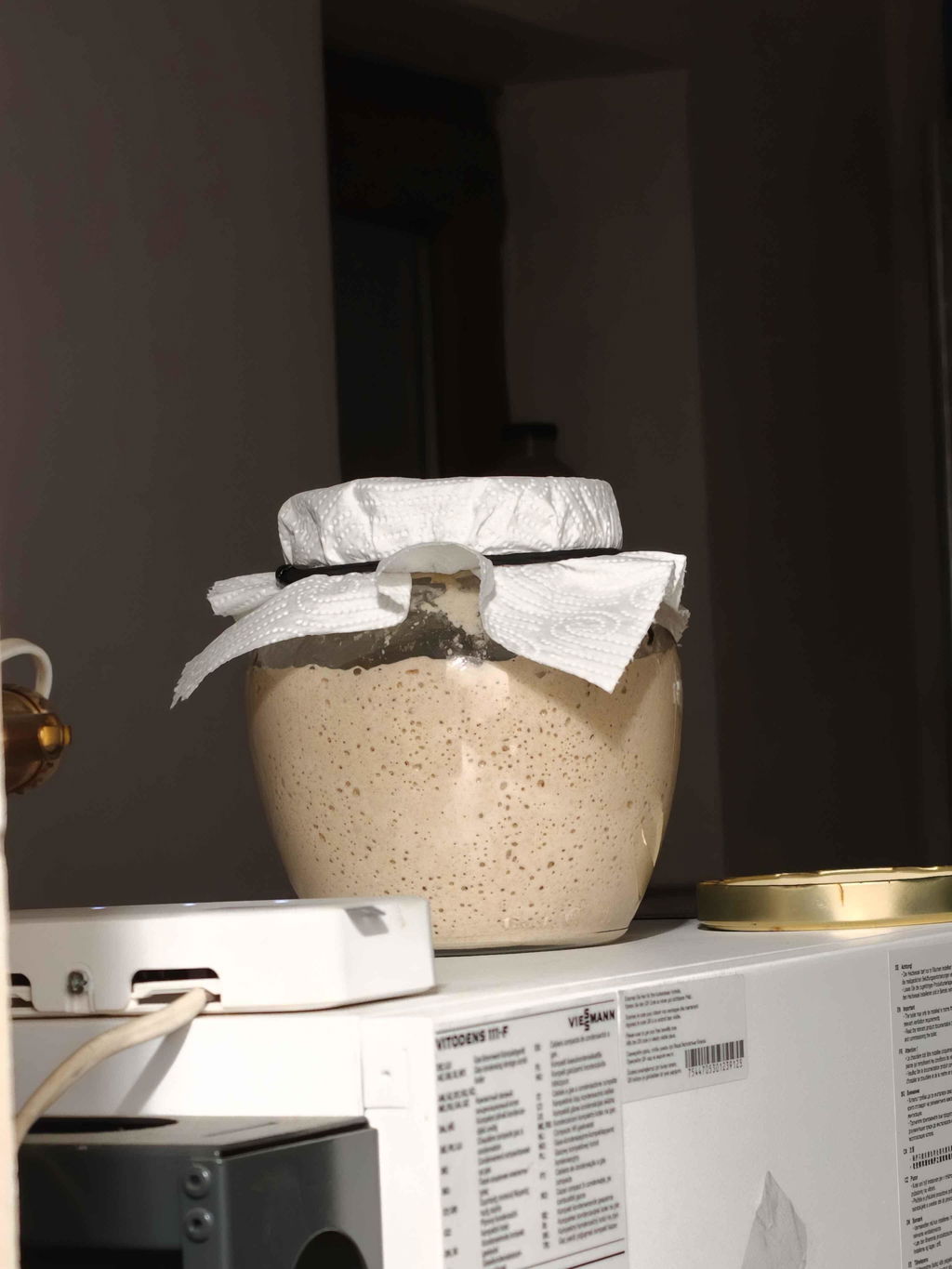
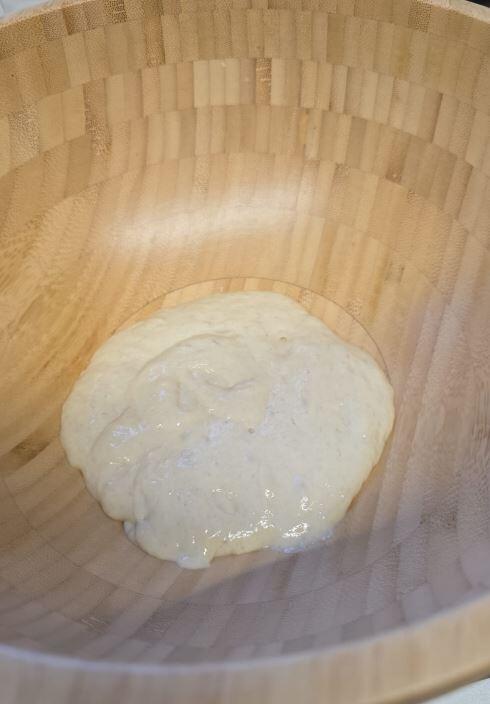
A healthy sourdough starter should have a consistency similar to that of of the pancake batter: thick enough to be viscous, but liquid enough to flow slowly off the spoon. When you lift a spoon out of the starter, it should drip slowly, indicating a good balance.
For precise adjustments, use a kitchen scale. Measurements in grams are much more accurate than those by volume. If the starter is too runny, add 10-20 g of extra flour at the next feeding. If it is too thick, add 10-15 ml of water. Adjust gradually and observe the changes.
After mixing, check whether you can draw a line in the starter with the spoon—the line should remain visible for a few seconds before leveling out. When you tilt the jar, the starter should slowly run down the sides, without sticking or suddenly sliding.
Remember that wholemeal flours absorb 15-20% more water than white flours. For example, if you feed your sourdough starter with 100 g wholemeal flour, you may need 110-120 ml of water to maintain the desired consistency.
Adjust the hydration gradually over 2-3 feedings. Small, consistent changes are more effective than sudden adjustments, which can destabilize the starter. Once you’ve found the right ratio, write it down (for example, 100 g flour to 110 ml water) so you can use it consistently. This will ensure efficient fermentation and steady growth, preparing the starter for the next stages.
Solution 5: Solve Problems in Maia
Even if you take care of temperature, feeding, and hydration, your sourdough starter can still show signs of problems, such as changes in smell, color, or texture. Unusual odors, strange spots, or other changes may indicate that something is wrong. The good news? Many of these issues can be fixed. However, it is essential to know when the starter can be saved and when it must be discarded completely. The guide below will help you tell the difference.
What Problems Can Be Solved and When You Should Give Up
The first step is to identify the problem. Not all changes are dangerous, and some can be corrected with simple adjustments.
Problems that can be solved:
- The hooch (the thin liquid on the surface) indicates insufficient feeding. You can stir it back into the starter or remove it, then adjust the feeding frequency.
- The smell of acetone signals a overfermented sourdough starter. The solution? Remove some of the starter and feed it with more water and flour.
- Kahm yeast, although it looks strange, it is not mold. Remove it with a spoon and continue feeding as normal.
- Oxidation may lead to dark spots or grey layers. As long as they are not fuzzy, they are not mold. Stir the starter and feed it as usual.
Issues requiring complete removal:
- Powdery mildew (green, black, white with a velvety appearance) indicates deep contamination. Even if the mold seems to be only on the surface, its filaments may be spread throughout the starter.
- Pink or orange stripes are caused by the bacterium Serratia marcescens, which is dangerous. If you notice such signs, throw away the entire starter.
In severe cases, the safest option is to discard the contaminated starter completely. Mold spores or harmful bacteria can remain even after you remove the affected part. After identifying the problem, you can begin the restoration process, if the situation allows.
How to Restore a Weak Sourdough Starter
If your sourdough starter is not contaminated but seems weak, there is a chance to bring it back to life. It requires regular feedings and precise adjustments.
- Remove 50–75% of the starter, keeping only the active part, usually the portion at the bottom of the jar. The rest can be discarded or used in recipes that do not require leavening.
- Feed the remaining portion with equal amounts of water and flour, measured in grams. For example, for 50 g of sourdough starter, add 50 g water and 50 g flour.
- Mix well, cover the jar with a breathable cloth, and leave the starter at room temperature (21–24°C).
- Repeat the feeding every 12 hours for 2–3 days, discarding part of the starter before each cycle. This routine helps rebalance the microorganisms and eliminate the by-products that slow fermentation.
After a few days, you should see signs of improvement: bubbles, increased volume, and a pleasant, slightly sour smell, similar to yogurt. If these signs appear, you can return to a normal feeding schedule, either once a day or every 12 hours, depending on the temperature.
If, after 4–5 days of regular feedings, the starter shows no improvement - it remains flat, with no bubbles and an unpleasant smell - the microorganisms may be too weakened to recover. In this case, start with a new starter, either homemade or purchased from a trusted producer, such as Fermented Maya, which provides active sourdough starter and detailed guides.
A healthy starter should double in volume within 4–8 hours after feeding, depending on the temperature. If this does not happen consistently after a week of care, it may need more time or a complete replacement.
Solution 6: Build your sourdough starter's strength
Even if you adjusted the temperature and fed and hydrated the starter, it may still not be strong enough for effective proofing. A young starter, only a few days or weeks old, has not yet developed the stable populations of yeast and lactic acid bacteria needed for vigorous fermentation. Likewise, a starter fed irregularly or kept in improper conditions may have weakened microorganisms, even if at first glance it appears healthy.
To develop a strong sourdough starter, you need patience and consistencyThere are no shortcuts - the sourdough starter must be fed consistently, monitored carefully, and tested before use. If it is used too early, the bread will be dense because the starter is not active enough.
After your starter begins to show signs of life, the next step is to strengthen it to achieve consistent baking results.
How do you check if the sourdough starter is ready
Before using the sourdough starter in a recipe, you need to make sure it is active enough. The most reliable method is the volume-doubling test. A healthy starter should double in volume in 4–8 hours After feeding, at a temperature of 21–24°C. If this does not happen, the starter is not ready for baking.
For the test, feed the starter in the morning with equal amounts of water and flour (for example: 50 g starter, 50 g water, 50 g flour). Mark the starting level on the jar using a rubber band or a marker. Leave the jar at room temperature and check after 4 hours. If the starter has doubled or almost doubled, that is a good sign. If after 8 hours it has barely risen, it means it needs more time and regular feedings to become stronger.
The signs of an active sourdough starter include lots of even bubbles, both on the surface and throughout. The smell should be pleasant, slightly tangy, similar to yogurt or fermented fruit. If you notice a strong smell of vinegar or acetone, this indicates an over-fermented starter that needs to be fed more often.
Although the float test in water is popular, it is not always reliable. The starter may float even if it is not active enough for leavening, because floating depends more on trapped gases than on the activity of the microorganisms. Therefore, the doubling-in-volume test remains the most accurate.
How to strengthen a weak starter
If the starter doesn't pass the doubling-in-volume test, don't give up. With regular feedings and careful care, you can gradually strengthen the microorganisms. The process can take between Between 1 and 3 weeks, depending on the initial condition of the sourdough starter and the conditions in which it is kept.
To begin, feed the sourdough starter Every 12 hours, removing 50–75% of the existing amount each time. Keep only 50 g of starter and add 50 g water and 50 g flour. This routine helps restore the balance of microorganisms and removes unwanted by-products. Regular feedings provide the necessary nutrients, allowing yeasts and lactic acid bacteria to develop better.
Ensure you keep the temperature between 21 and 24°C for stable fermentation.
The type of flour is important, especially at the beginning. Use a blend of white flour and whole wheat flour for a few days, then gradually switch back to your preferred flour.
Monitor the progress daily. After 3–5 days of consistent feedings, you should notice more bubbles, faster growth, and a more pleasant smell. If, after 7–10 days, the starter still doesn’t double in 8 hours, check the temperature, hydration, and flour quality again. If all of those are correct, but the starter remains weak, you may need to start a new starter, either homemade or purchased from a trusted source, such as Fermented Maia, which offers active sourdough starter and detailed care guides.
A mature and strong sourdough starter will become predictable and consistent. You will be able to accurately predict when it will double in volume after feeding, which will allow you to plan your baking successfully. This consistency is a sign that the yeasts and bacteria are well balanced and active enough to leaven the bread.
Conclusion
A starter that isn’t developing doesn’t mean your baking journey is over. The six solutions discussed—adjusting the temperature, changing the feeding schedule, using better flour, balancing the water-to-flour ratio, fixing issues in the starter, and strengthening it—cover the most common causes of weak fermentation.
The starter reacts to the environment it is in: low temperatures slow down the fermentation process, irregular feedings weaken the microorganisms, and poor-quality flour does not support the development of the essential yeasts and bacteria.
Success comes from carefully monitoring these factors. A healthy starter does not appear overnight - it needs time to develop a stable population of microorganisms. Regular feeding, maintaining a constant temperature, and using quality ingredients are essential to turn a weak starter into a strong one, capable of leavening a perfect loaf of bread. Consistency and patience are what make the difference and turn any challenge into a step forward.
Pay attention to your starter's signals: the time it takes to double in volume, the appearance of the bubbles, and the smell are clear indicators of its condition. Over time, you'll develop an intuition that will help you work with your starter without relying on a timer or strict recipes.
Applying these six solutions correctly, you will achieve a robust starter and quality bread. If, however, after 2–3 weeks, the starter still shows no signs of life, it may be time to start a new starter and rebuild the foundation for successful baking.
FAQs
How can I check if the temperature in the kitchen is suitable for my sourdough starter?
The ideal temperature for sourdough starter to rise healthily is between 20°C and 25°C. If your kitchen is cooler, the fermentation process will slow down. On the other hand, if the temperature is too high, fermentation can become too rapid, which could affect the taste and texture.
For monitoring the temperature, a room thermometer can be very helpful. If you notice that the temperature does not fall within this range, you have a few simple solutions. If it is too cold, you can place the starter in a warmer spot, such as near the stove or in a cupboard protected from drafts. If it is too warm, find a cooler place or, for more precise control, use a proofing box with adjustable temperature. The latter is an excellent solution for maintaining optimal conditions.
What type of flour is best suited to revive a sourdough starter that is no longer rising?
To bring back to life a sourdough starter that is no longer rising, try following the author's whole wheat flour or rye flour. Ac from types of flour are full of nutrients and microorganisms that can help reactivate the starter.
It is important that the flour you use is fresh and of good quality. If your sourdough starter seems very weak, feed it only flour wholemeal flour for several consecutive days for an extra boost of energy. Also, the temperature in the kitchen plays an essential role. Make sure it is between 22°C and 26°C``, the ideal interval for fermentation. This way, you have a better chance of seeing positive results.
If I feel that my starter is too runny or too thick, and what can I do to fix these issues?
If your starter seems too runny, you'll notice right away: it has a watery texture, doesn't hold its shape, and the bubbles that form are large and fairly sparse. To fix this, start adding flour gradually, mixing well after each addition, until you get a thicker, more elastic consistency.
On the other hand, if the starter is too dense, you’ll notice that it’s hard to mix and that the fermentation process is slower. The solution? Add room-temperature water, a little at a time, stirring carefully. Keep adjusting until you reach the desired texture, but be careful to maintain a balance between hydration and firmness.



1 comment
Foarte clare si detaliate explicatiile acoperind tot ce ne putem imagina. Bravo si multumesc!